An office phone booth—a standalone, soundproof space placed directly into the office environment—provides employees with a quiet place for calls, focused work, and video conferences without the need for renovations or new construction.
This guide explains what to look for, how to compare models, and how to calculate the return on investment.
(7-minute read)
Open-plan offices still dominate most Swedish workplaces. According to a report from the Swedish Work Environment Authority (2023), 43 percent of office employees experience distracting background noise as a daily problem. A phone booth solves this without the need to lease new premises or build permanent walls.
Hybrid work has further amplified this need. When employees commute to the office for collaboration rather than solo work, more short conversations and video meetings occur—exactly the type of activities a phone booth is built for. Market analysis firm Global Workplace Analytics (2024) estimates that the demand for acoustic pods and booths in Europe is growing by approximately 18 percent per year through 2027.
A phone booth—often called a phone pod or acoustic pod—is sized for one to two people and is primarily designed for short calls and focused work. A quiet room, or meeting room in pod format, usually accommodates four to six people and is intended for longer meetings and workshops. The distinction between them lies in size and purpose: the booth prioritizes quick accessibility and a minimal footprint, while the quiet room prioritizes capacity and equipment levels.
Sound reduction is often stated as an Rw value (weighted sound reduction index) or as a simple dB figure. A well-built phone booth delivers 30–40 dB of reduction, which in practice transforms open-office noise to a level comparable to a quiet library. Anything below 28 dB provides insufficient shielding for sensitive conversations.
Ventilation is one of the most critical factors. Active ventilation—a fan system that circulates air continuously—is necessary in booths intended for stays longer than 15 minutes. Passive ventilation is rarely sufficient for longer sessions. Also, check that the booth has at least one EU power outlet and built-in USB-A/USB-C charging; most models on the market have offered this since 2022. Furthermore, all booths placed in Swedish workplaces must meet the Swedish National Board of Housing, Building and Planning's (Boverket) fire safety requirements—always ask for certification that the materials are rated at least B-s2,d0 according to the European standard EN 13501-1. Finally, an average pod weighs 200–600 kg, so check the floor's load-bearing capacity, especially in older buildings.
Base your decision on the use case, not the available floor space. A pod intended for occasional calls only needs room for one person plus a chair—typically 0.9 × 1.2 meters. A pod for video meetings with a shared screen needs at least 1.2 × 2.0 meters to provide comfortable movement space and acceptable image composition for the camera.
A rule of thumb from the office design standards in ISO 11690-1 is to plan for one booth per 8–10 employees in an open-plan office. If you have an activity-based office with high phone activity, the ratio may need to be tightened to 1:6.
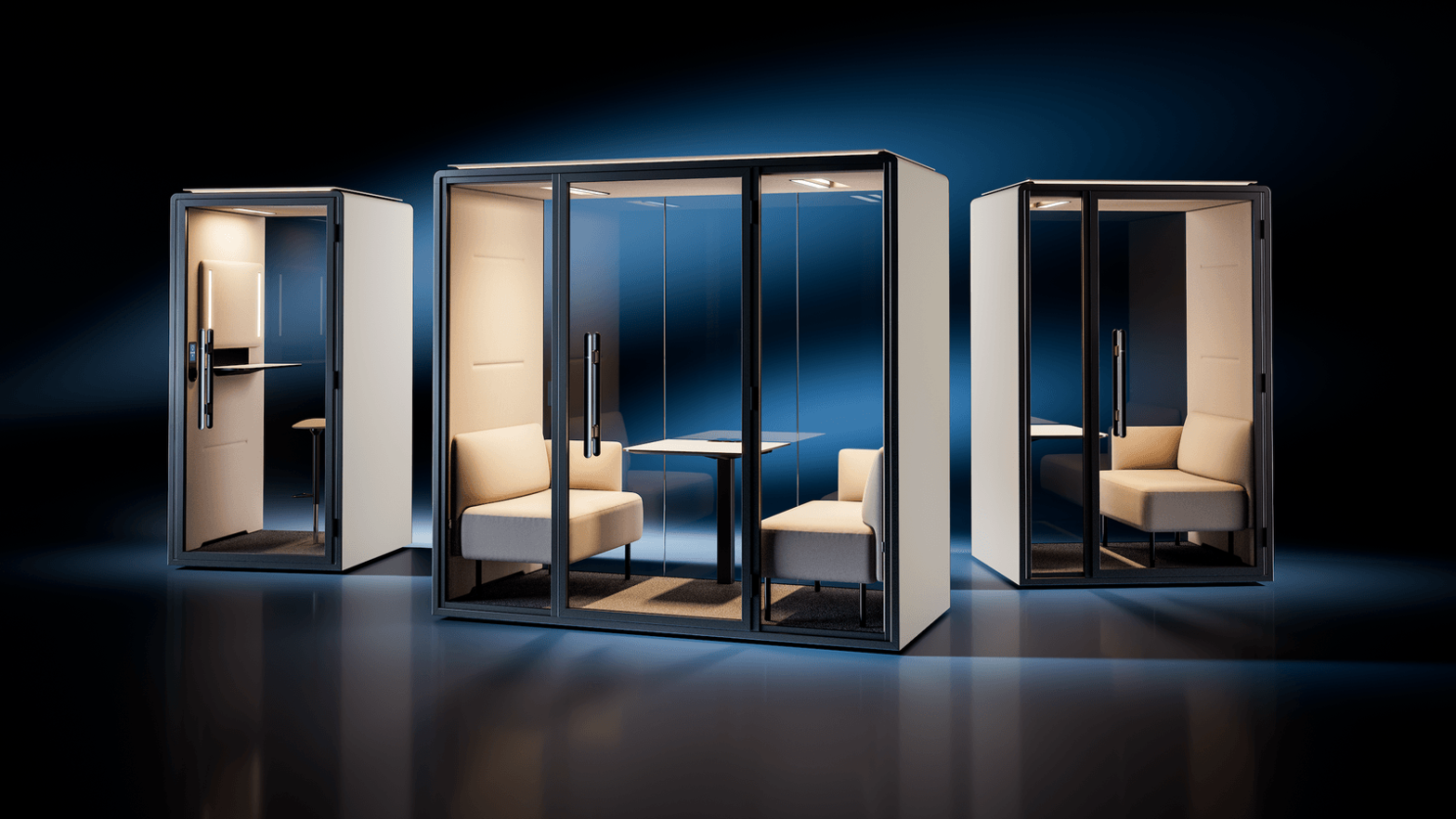
The Swedish and Nordic market is dominated by about ten manufacturers divided into three price categories. Single-person pods—Silen S, Chatbox S, Evavaara S1, and Octacell 1×1—typically cost 49,000–95,000 SEK excluding VAT and shipping. Space Call is ISO-certified and has documented Class A sound dampening. Two-person pods like Silen Space, Chatbox M, and BlockO are suitable for short team meetings and video conferences for two, and are priced in the 55,000–195,000 SEK range. Meeting rooms in pod format—Octacell 4×4, Space Meet, and BlockO XL—are built for 4–6 people with a screen and whiteboard surface, costing 90,000–250,000 SEK depending on the interior level and technology package.
The price ranges refer to list prices for 2025. An independent advisor at Klickbara Rum can help you evaluate the total value rather than just the list price.
The purchase price is only part of the total cost of ownership. Also factor in delivery and installation (usually 2,000–8,000 SEK), any electrical connection by a certified electrician, and ongoing maintenance of the ventilation filters, typically once or twice a year.
On the revenue side: if a phone booth prevents an employee from interrupting their deep work to search for an available conference room, it saves an estimated 20–30 minutes of productive time per incident. With 10 employees each looking for a place to take a call three times a week, this adds up to over 1,000 lost working hours per year — a value that far exceeds the cost of an average booth.
Leasing and renting are common options that spread out the cost and provide the flexibility to switch models as needs change. Klickbara Rum offers financing solutions tailored specifically for that type of flexibility.

Most modern phone booths are plug-and-play: they are assembled on-site by the supplier's technicians, require no building permits, and leave no permanent marks on the premises. Assembly time for a single-person booth is typically four to eight hours. The only thing you need to prepare is a nearby power outlet — most booths draw 200–400 W during normal operation.
Placement affects the experience more than most people realize. Avoid placing the booth near coffee machines, restrooms, or high-traffic zones — not for acoustic reasons, but because the sense of privacy decreases when colleagues pass by closely. A location along a wall or in a corner is perceived as more secluded and is therefore used more frequently.
Phone booths are made from a mix of steel, aluminum, glass, and acoustic foam. Choose models where the manufacturer can verify the origin of the acoustic foam — PET-based recycled material is preferable to petrochemical polyurethane foam from a climate perspective. Several leading manufacturers, including BlockO and Silen, publish product-specific Environmental Product Declarations (EPDs) that make it possible to compare climate footprints objectively.
Another sustainability advantage of modular booths is that they can be disassembled and reused when moving. This makes them a more sustainable option than traditional drywall, which almost always ends up as construction waste during relocation. Klickbara Rum also offers buy-backs of used booths, which are then refurbished and resold as sustainable second-hand solutions.
A well-constructed phone booth reduces ambient noise by 30–40 dB, which corresponds to the difference between a busy open-plan office (about 65 dB) and a quiet library (about 30 dB). Sound reduction depends on the construction materials, the quality of the seals around the door, and the design of the ventilation system. Always ask for the measured Rw value in the product sheet — not just the manufacturer's marketing claims.
No, freestanding phone booths and acoustic pods generally do not require a building permit because they are not permanent structures and do not affect load-bearing constructions. However, check your lease agreement with the property owner, as some landlords require approval for interior changes of a certain size or weight.
The terms are used somewhat interchangeably, but in the industry, a distinction is usually made based on the use case: a phone booth is designed for voice calls and shorter video conferences and often has a small, vertical workspace. A focus booth — sometimes called a focus pod — is optimized for longer desk work and features a full-sized workspace, adjustable lighting, and, in some models, a height-adjustable desk.
In-stock standard models are usually delivered within 2–6 weeks in Sweden. Custom configurations — non-standard colors, special fabrics, or integrated technology — can have lead times of 8–16 weeks depending on the manufacturer. If you are planning a total office renovation, it is wise to order booths well in advance, preferably in parallel with other interior design decisions.
Yes, leasing and operational rental are common financing options for phone booths in Sweden. Leasing spreads the cost over typically 24–60 months and can often be recorded as an operating expense rather than a capital asset, which improves the balance sheet. Operational rental also provides the flexibility to upgrade to a newer model once the contract period expires — an attractive option for fast-paced office environments.
As a general rule of thumb, we recommend one booth per 8–10 employees in an open-plan office, in accordance with the ISO 11690-1 office design standards. In environments with high levels of phone or video conferencing activity — such as sales, support, or consulting — the ratio should be 1 booth per 5–6 people to avoid queues and employees avoiding the use of the space.
At Klickbara rum, we want to help you choose the right model for your specific needs and requirements.

Complete your project with solutions tailored to your needs — customized, modular and ready in one click
efter dina behov – skräddarsydda, modulära och redo med ett klick
- We Make Work A Better Space